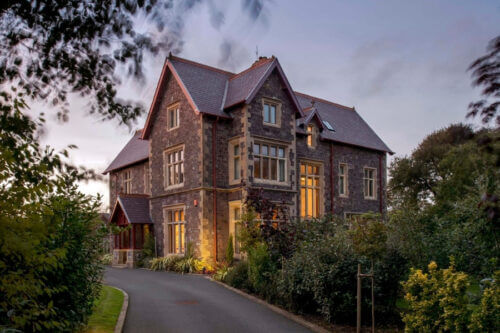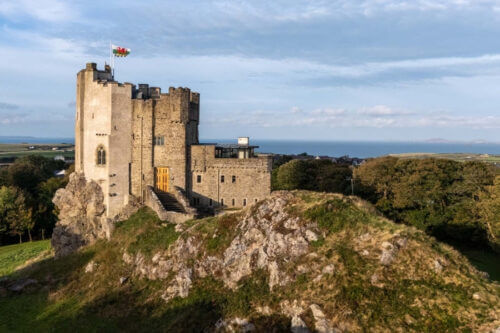



During the Second World War, Twr y Felin’s windmill tower took on a very different role from the one it had served in peacetime. The tower became part of a secret coastal listening station operated by the Women’s Royal Naval Service (WRNS), with Wrens stationed in St Davids carrying out highly confidential work monitoring German naval communications.
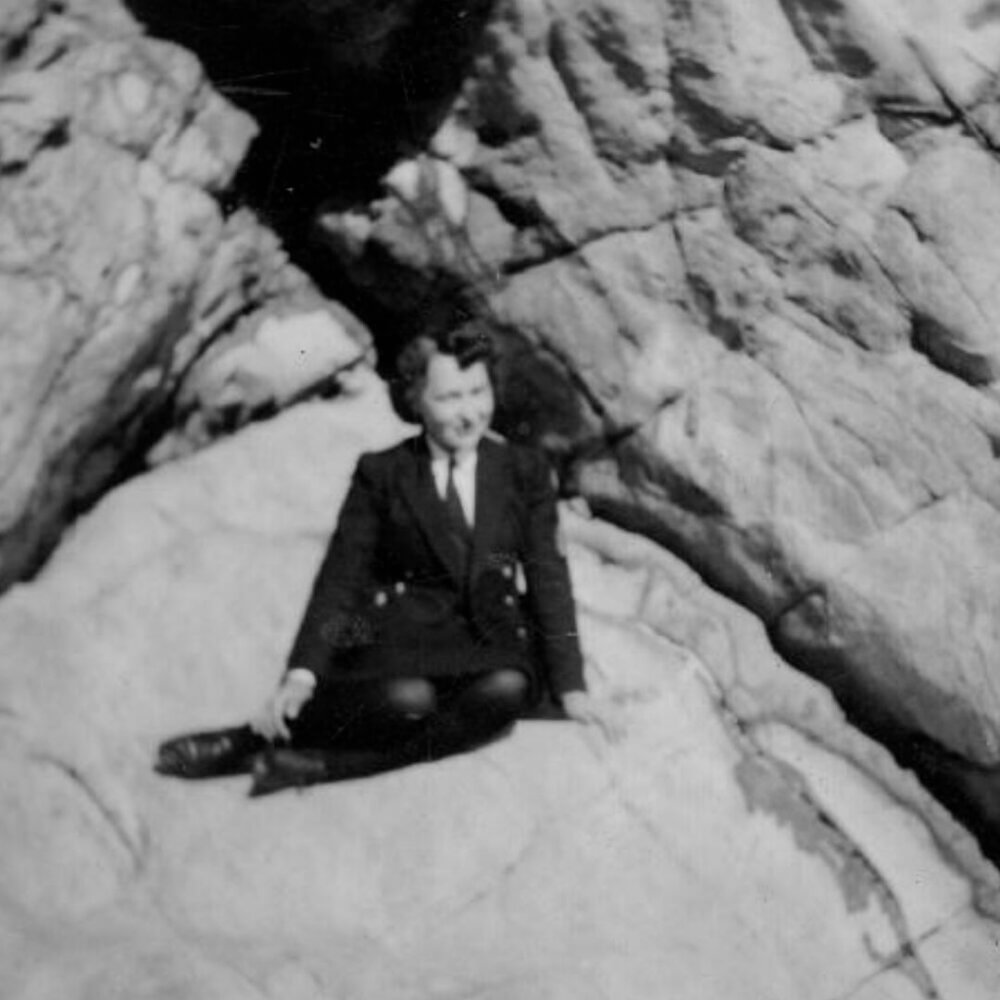
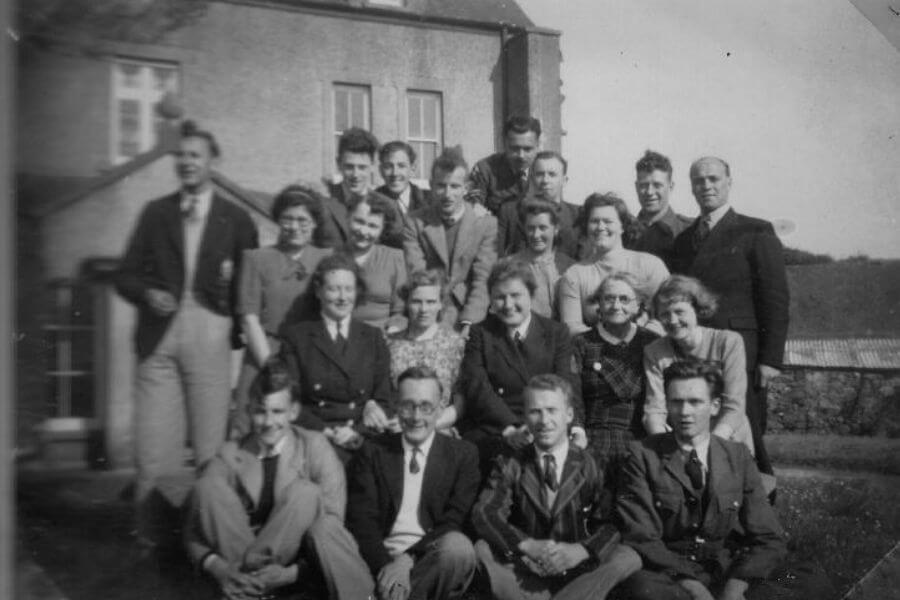
We have been incredibly fortunate to have been entrusted with a remarkable collection of personal material from the family of Dorothy Robertson, who was stationed here in 1943. Alongside letters and photographs of Dorothy and her fellow Wrens, the family has shared photographs of Twr y Felin and the surrounding area, as well as Dorothy’s memoir, My Memories of WRNS Days – 1943–45. Together, these materials provide a rare and deeply personal insight into life at Twr y Felin during the war, bringing to life not only the work carried out within the tower, but also the women who lived and worked here.
Dorothy recalled arriving in St Davids after completing specialist training in London, having been appointed as an Acting Petty Officer in Special Duties. She described the WRNS station as a converted building with a circular watchroom at the top, where two Wrens at a time worked around the clock.
Their role involved listening for German naval communications on VHF and recording messages that could be of operational importance. The work was conducted in secrecy; the local community had little idea what was taking place inside the station, and even visiting naval officers were restricted from entering the watchroom.
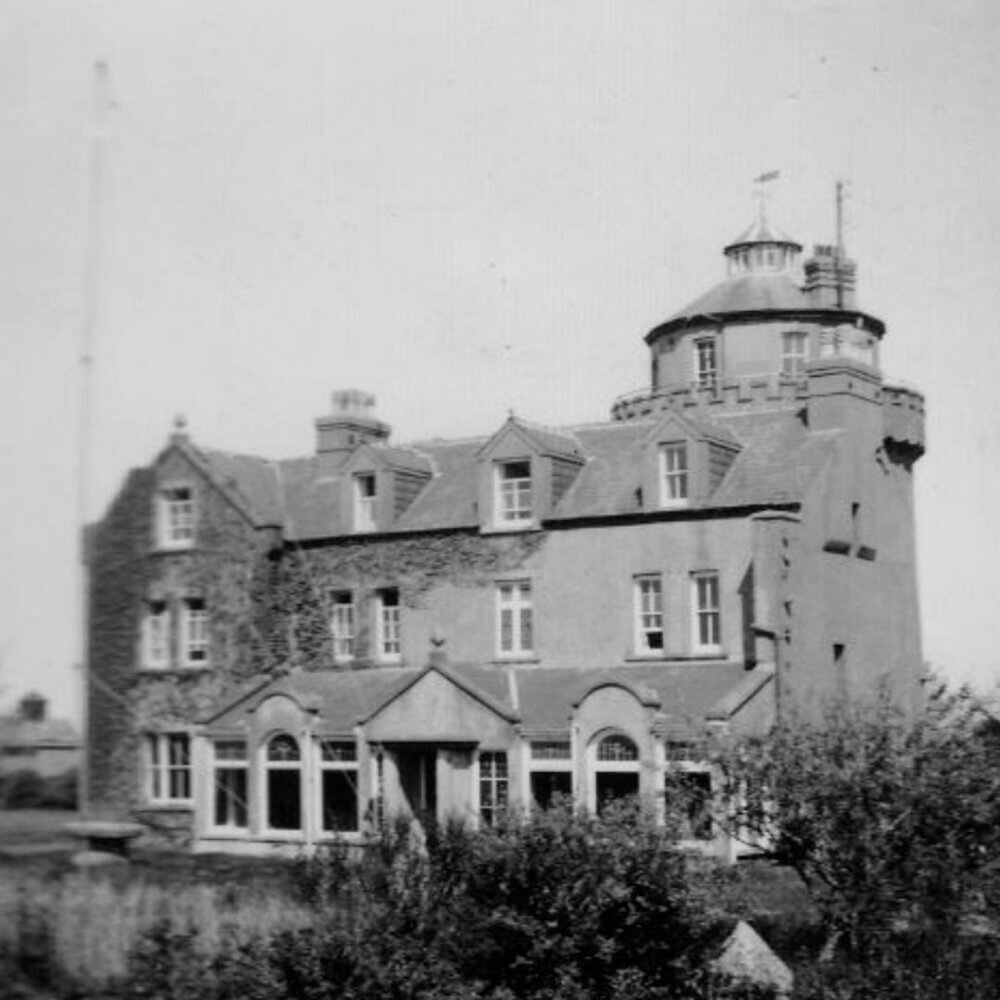
Dorothy’s memoir gives us a rare opportunity to understand this history through the eyes of someone who experienced it herself. Her memories capture both the seriousness of the work and the everyday reality of life in wartime St Davids, from exhausting watches and the fear of falling asleep on duty, to walks along the coastline and the friendships formed within their small, isolated station.
The letters, photographs and memories shared by Dorothy’s family allow us to look beyond the building itself and remember the people who became part of Twr y Felin’s wartime story.
Dorothy’s Story
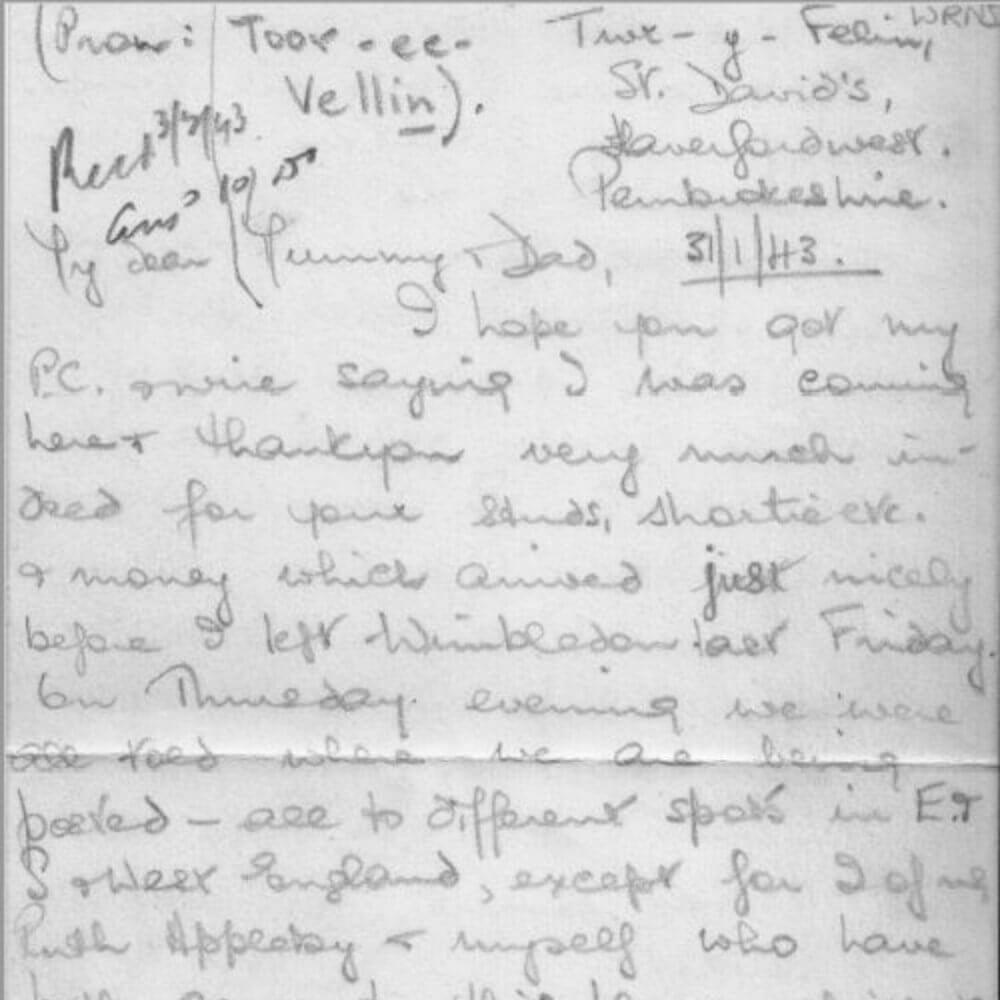
Read Dorothy Robertson’s own memories of her time as a Wren at Twr y Felin during the Second World War, alongside a letter she wrote home from St Davids.
A Letter Home
My dear Mummy & Dad
I hope you got my P.C. wire saying I was coming home & thank you very much indeed for your funds, shortie etc. & money which arrived just nicely before I left Wimbledon last Friday.
On Thursday evening we were all told where we are being posted – all different spots in E.T, S & West England, except for 2 of us. Ruth Appleby & myself who have both come to this place which is terribly isolated (like Orkney!) but I think I’m going to like it.
Anyhow if we don’t like a place we get moved after 3 months. Ruth and I share a cabin with a whole bed (not a double decker) each, and hot & cold in our cabin but the rest is very farm e.g. like bare floors, oil lamps, scarcely any furniture etc! There are about 12 of us altogether on the radio which is a converted sort of fishes’ hovel (e.g. Kil-Drummy) with a huge sort of lighthouse down where we do our ‘watches’. I am on standby duty from 9am – 7.30pm. Today with Ruth on watch. Tomorrow I’ll be on watch from 8.30am till 1.30, then possibly Wed. morning 4.30am. & so on, any time almost, for about 5 – 7 hours.
I spent Friday night/evening with the Wedgewoods as we got a stepping out pass if we wanted it. They are most awfully kind & keep asking me back, so I was sorry to be sent so far from London. But we were warned that this job sometimes (not always) leads one to isolated spots. Some stations are lively both in work & socially so it’s better to start at a dull one & get that over. They say that they try to make it fair by letting everyone have a while at a quiet station.
Ruth & I think we were, probably sent together as we were the 2 younger in our lot – I’m actually the youngest of our course who got through, Ruth is 22.
I thoroughly enjoyed the Wimbledon course although we all found it an anxious one from the work point of view. I left Wedgewood’s at about 10.30am on Saturday and met Ruth at Paddington in tons of time for the 11.55 train to Haverfordwest. I took a cab as it was teeming rain and also I had 2 terribly heavy cases & the wind kept blowing my hat off into the gutter.
The old bomb damage about Oxford Street & Hyde Park was quite bad – not so much demolished buildings, although there were plenty of those, – as defaced & untidy looking buildings, damaged rather by blast, especially round the Hyde Park area.
We were packed, 8 in a compartment all the way but I didn’t find it tedious somehow. For the first half, till Cardiff, a Scots Tommy & a Canadian Tommy kept up a series of most lively arguments about things in general. A wifie in the corner seat turned out to come from Peterhead, later an attractive young couple & dear little baby boy, 6 months, in a cot, came in.
The baby was so good and looked just like Valerie at that age. There was no country worth seeing as it was all so flat and raining most of the time too. S. Wales is just like the north of Scotland – treeless and wild, but rather nice too. We are right on the coast (about 300 yards from the cliffs) and about 100 yards from the village of St Davids. This village has hidden treasures – in the shape of a magnificent cathedral, the ruins of which are simply lovely, complete with ruined aisle and rose windows, and the newest part (about 11th century Norman) which we had the service in today. It’s like the church Edith’s wedding was in only much more elaborate. Cathedralish, with lovely arches & doorways & pillars & sculpture.
Inside all the framework is grey white and the choirboys wear cyclamen Robes under their sunglasses. It’s really beautiful. I’m looking forward so much to being shown round it.
So far my impressions of Wales summed up in the feeling that it’s exactly like Scotland – that is, Buchan.
We were paid last Thursday for a fortnight – guess how much we got! – (Incidentally, we get P/O’s pay even though we are only AP/Os for 3 months) – 35/- a week! 6h Boy – 5/- a day all found. It really is the best position (P/O) in the service, I think, because you get privileges that ratings don’t get, more pay, & you don’t have to pay for quarters like officers. London does run off with the cash though, – you can’t help it, travelling, & left luggage and so on.
Anne & I were very keen to go together to a station but she was sent down to the Devon coast unfortunately. However Ruth is a very nice…
My Memories of WRNS Days
I graduated MA at Aberdeen University in June, 1942, aged 20 my degree being a general one, with ordinary French and Advanced German included. In Scotland one has to take a variety of subjects (some obligatory), to make a minimum of seven, more if possible. Two of us, keen to join the WRNS (the Women’s Royal Naval Service), went down town literally the next day to sign on.
For days, weeks and months I ran to the front door – three deliveries per day in those days! – hoping my call papers had arrived and as time went on, it seemed that they simply did not want me. I had no job, so filling in the waiting time wasn’t easy. However, the Great Day dawned when at last a letter arrived asking me to report to the WRNS Depot in Mill Hill, London, in January 1943. I was simply thrilled. My mother too, was glad for me but my old fashioned father, wishing to keep his youngest at home, threatened to write in protest to the Admiralty! Needless to say, I was horrified……
The depot at MiIl Hill (HMS Pembroke III) had been a cancer hospital, now converted to receive hundreds of Wren recruits, and I mean I00’s – they were everywhere in this huge modern building. The first day we had to line up to give our names, etc., special abilities and so on, and to receive our Service Number; mine was 59,1516. Then one after another, we were submitted to the indignity of having our hair combed! We were very amused, never having had such an experience before.
Mill HiII kept us for two weeks, (during which time we aII slept in huge dormitories (former wards, obviously), each having the name of a Royal Naval ship. I think mine was Warspite. After breakfast we had to report for ‘house duties’ and for some unaccountable reason, another Scots girl and I were always sent to clean the baths, loos, etc. on our floor. Off we trundled with buckets and cloths, in fits of laughter. (The girl, a pretty little blonde called Deva Cayzer, asked me to post a letter for her one afternoon when I went ‘ashore’, (ie. out), and I noticed that it was addressed to Lady Cayzer in some castle in Perthshire. When I told my parents they were very amused, realising that Deva belonged to the very wealthy shipping family of Cayzer, and, and indeed after the war I read a long account of a posh wedding in the Daily Telegraph: “At St. Margaret’s, Westminster, the Hon. Deva Cayzer…… to…..plus lots of bridesmaids, etc.” So much for our initial training with buckets and cloths at Mill Hill.)
One day while at Mill Hill, I was taken alone to the Admiralty to have a test in German. Of course I was terrified, but found the atmosphere quite informal, and I must have passed because I was sent to Wimbledon where, with a few others I did an intensive and very exhausting two weeks’ course in Special Duties (Linguist), highly secret at the time, all of us having to sign the Official Secrets Act. As I rewrite these memoirs in the year the year 2000, I am now allowed to say that we were, in fact, being trained to listen to live German on VHF, plugged into 2 sets, one for each ear, and to log it as rapidly as possible. We were taught a certain amount of shorthand, e.g., at the end of every message, where the British would say “over”, a German would say “Frage verstanden? Feryig,” meaning “Question/order understood? Finish.” This we logged as simply as ‘Yg.’ And so on. But as we only as yet intercepted P/L (plain language), it simply could be very stressful trying to catch up on the German transmitter.
Of course we also had to learn German shorthand for many German naval terms; our teacher would be transmitting to us from a next door room and would come in at the end of a session to discuss results. There were about I0 of us on this course, all worried stiff that we’d fail the finals at the end of the two weeks. On the last day our teacher, a rough old naval chap who had never fully accepted the idea of women in the Navy, duly transmitted from the next room, including, of course, ‘interference noises and garbled speech’, which we frantically logged for some time,(R/T = radio telegraphy) . When he finally came in to us afterwards, we aIl gasped “Mr. Hatch – how was it??? In sly humour, he grudgingly replied “Bloody perfect.” We were so relieved, amused, and delighted to know that we girls could cope as well as men. It was actually confirmed after the war that women were as good as, and often better than, man at detailed jobs.
While at Wimbledon we were billeted in a very pleasant house, “Rosemead” 22 Inner Park Road, Southfields (now, sadly demolished & replaced by a block of flats), and did our training in another house nearby. Many and evening we would go up to the West End and, fearful that we might be back later than the regulation time, we would ask the other girls in our dorm to make a heap of kit- bags or suchlike in our bunk so that the duty officer Wren at lightsout would think that one was in bed. There was a very handy French window in our ground floor room and we and we would sneak in there late. I remember once seeing a huge pile in my upper bunk, being amused that Second Officer should take that hulk for ME! It was no joke those days going out at night in the blackout, no lights of any kind, one walked to & from-the bus in complete darkness, a thing I would never do today, but during the war there was little or no danger – a different spirit altogether. You even bumped into people sometimes, Iaughed & walked on.
With others on my course, I was immediately given the rank of Acting Petty, Officer (A P/Q) Special Duties and was posted alone to St. Davids in Pembrokeshire (H.M.S. Skirmisher). Although I came from Scotland and had often been in remote places I can still remember the feeling of desolation at the train from Paddington Station carried me further and further, it seemed into the wilds. St. Davids was and still may be a tiny village on the Southwest tip of Pembrokeshire; our Wrennery was a sort of converted lighthouse with a circular room on top with windows all around, which was our watchroom. Nobody other than ourselves knew that we had VH/F sets in it, plus D/F equipment, and indeed, when Chief Officer visited from MiIford Haven, our Naval Base, she was not allowed in. We had only one Wren Officer in charge, she herself of course, a Special Duties person. Only 2 Wrens manned the sets, 1 for the W/T (morse) operator, and for the linguist, with one set plugged into each ear. The sets were never switched off, being manned day & night in naval watches; we covered regular frequencies and also spent long weary hours “twiddling”, ie, searching the wave-bands for live German which, if we heard it, we had to rapidly log and decide whether it was important (operational) or not. It could be quite stressful, especially if there was bad reception distorting signals, and time was of the essence. Our VH/F range covered only some I5 miles, our main targets being German E-Boats and R-Boats (MTB’s) in British waters. Submarines were usually in deeper waters and were covered by men on ships at sea. Our listening stations were usually old lighthouses or similar buildings high on cliffs overlooking the ocean. I asked Tony Sale, head of Bletchley Park in 1998 or so while there on visit, why we had only two Wrens on watch at any time, and he told me due to shortage of personnel. We often wore civilian clothes; moreover, we never had a category badge on our uniform, factors which I now think were to encourage our anonymity, perhaps. The local folk had no idea of what we were up to, and no doubt there were many rumours! OnIy a few years ago I answered a letter in The Wren magazine from a young male historian if ‘anyone knew what exactly went on at the secret cliff radio station at Coverack, Cornwall, during the war? In his study of the area he had been unable to find any information and was grateful for mine.
Interception of enemy messages was called “Y” category. While the P/O listening for German R/T operated her two sets, her W/T colleague sitting alongside was searching for and logging, signals in German morse code. If either considered her signals important, she rapidly logged them, giving time of origin (T.O.O), frequency, from whom to whom if possible, in the German & shorthand she had learnt. If she considered it necessary, she had to telephone her information to Intelligence Centre (I/C), to us, simply a telephone number. Only in 1998 did I learn from BP that I/C was in fact, Bletchley Park! Unfortunately one never had any feedback at any time during my 3 years of service, no doubt for security reasons.
There were many regular frequencies which we covered at given or set times of the day or night. These might be from German outposts of vessels or naval stations. We had long tedious hours in naval watches in a 4-day cycle, endlessly searching the wavebands, relieved sometimes by the sound of German speech, reception not necessarily good, so rapid logging began. Frantic! As we worked, all round the clock we never reaIIy caught up on sleep and dreaded the possibility of falling asleep on watch. We also had to take turns in sleeping a night alone in a wired-off hut in a nearby field where if necessary, one had to take D/F bearings on any signal telephoned through by the watchroom. It was quite creepy being locked all night alone in the hut, and I remember once when the phone rang from the watchroom leaping out of bed, shivering in my nightdress, plunging into a large puddle on the floor, then trying to take a bearing on a signal – panic stations! This small Wrennery at St. Davids was a very happy, if spartan, station in spite of the fact that we were miles away from everything and everywhere except the village a tight Welsh community who looked on us all with deep suspicion. In our free time we went beautiful walks along the coastline and deserted bays, and spring in SW seemed to start earlier and look lusher than anywhere I had seen before. Of course, a romance with one of the theological students evacuated from Llandaff College in Cardiff may have had something to do with that.
From St. Davids I was suddenly transferred at 24 hours’ notice in June ‘43 to Withernsea, East Yorkshire, on the Humber (HMS Beaver) – a dreary second rate seaside resort. At first I hated it; the flat colourless countryside really was depressing and the roIls of barbed wire in front of our Wrennery on the beach, quite inaccessible, unlike those in Wales, made it more so. The only form of amusement was a large dancehall, but we didn’t like it at all. However, it was here that I met two P/O Wrens like myself who were to become lifelong friends: Sheila Cassie (“Baxie”), her middle name being Baxter, Anne Robson from South Africa. We three were to spend almost two years together later in Ceylon, where we were great friends. At Withernsea I can remember while on watch with my headphones on, hearing German bombers flying low over us on their to bomb Hull, their pilots yelling to each other, their call signs the names of flowers, e.g.: “Hello-hello. This is Daffodil…..calling Tulip, Tulip etc.” Screaming. Very nasty. We knew the local WAAF (Women’s Auxiliary Air Force) would be covering it, so we did not log it in detail, Hull was indeed badly bombed many times.
After summer 1943 in dreary old Withernsea, some of us were transferred to Scarborough, (HMS Paragon) – totally different again, big base lots of red tape. Ugh. A high class summer resort in pre-war days, now stiff with service personnel of all sorts, esp. RAF, there being ?8 aerodromes all around it. It was the biggest base that any of us had been in; up to now we had been spoiled in small stations with only 12 or so others and one Third Officer. Now it was ‘Big Base’ with uniforms, saluting, squad drill, rules, no privacy, and Wren Officers everywhere bossing us around. Work was no longer ‘upstairs’ at the top of the house – we had to go in coaches to a huge W/T station outside town. AIl I can remember is the huge watch room full of naval personnel-, male & female and the enormous mugs of thick strong cocoa brought to us twice on every night duty – just the thing to make one sleepy! – when to fall asleep on duty was every Wren’s nightmare. In Scarborough we had to keep reading the noticeboards, etc. and were horribly regimented, a thing we had been lucky to avoid up to now, Anne Robson & I were billeted out in an erstwhile summer lodging house, where it was very cold, the wind whistling through gaps in our bedroom wall. Our Quaker landlady was so strict that we had to beg to be allowed to fill our hot water bottles every night. Ugh. While at Scarborough we learnt that volunteers were wanted to go overseas, so of course, Anne & I were immediately keen and sent up the appropriate forms. At first we were terribly disappointed when the first six did not include us, but a few weeks later we were both accepted in the second six – what a thrill! And it was to be Ceylon, aII the more exciting for me as I had been an infant in India, thereby fulfilling my lifelong ambition to go East again. I could hardly contain myself, but of course, was unable to tell even my parents (it being top security,) who knew India and my father, Ceylon, so well. My parents had retired from many years in India in 1929. One could only tell people one was going ‘overseas’ and not of course, when or where.
Eventually Anne & I were sent from Scarborough to start our 2-month course at Bletchley Park (HMS Pembroke V), in Bedfordshire, and were billeted with some other 500 Wrens – all doing different jobs about which none of us knew anything – in Woburn Abbey, the huge mansion belonging to the Duke of Bedford. This was in January & February, 1944, and we reaIly hated the place; it was freezing cold, dark dingy, our loo water was usually frozen up – truly Spartan. Our bedroom for 6 was huge & empty, with a beautiful plaster ceiling, overlooking the Orangery, so no doubt a main room normally. All it contained was double-decker bunks, a few chairs and plain chests of drawers; it was so draughty that I thought I would be blown off the top bunk. (This room is not accessible to the public now, being in the private apartments.) The loo had been very grand once with a long passage leading up to the ‘throne’, but antiquated now. But we used to laugh lots …..no doubt we had to!